The buyer is still learning the category
Half of a discovery call is education. That's fine — but it means the deal advances through understanding, and the CRM needs to record what's been explained and to whom.
AI deals rarely close on a demo. They close after an evaluation, a data-access conversation, a security review, and a pilot that has to prove something. TotalDeal keeps the stakeholders, technical commitments, and success criteria on the opportunity — and carries them into implementation once you win.
The product is often the easiest part of the conversation. What slows an AI deal down is everything around it.
Half of a discovery call is education. That's fine — but it means the deal advances through understanding, and the CRM needs to record what's been explained and to whom.
Your solution needs their data, and getting it involves a data owner, a security reviewer, and often a legal step. That commitment needs to be written down, not remembered.
Success criteria get agreed verbally, the pilot runs for six weeks, and then everyone disagrees about whether it worked. A pilot without recorded criteria is a deal you can't close.
Model behavior, data retention, sub-processors, DPA terms. This is a stage of the deal, and treating it as one is the difference between forecasting accurately and guessing.
Integrations, data pipelines, and configuration differ per customer. What sales promised has to reach the people who build it.
Moving from pilot to production means going back to the economic buyer with proof. The evidence needs to be somewhere you can find it.
If your product sells itself through an API key and a credit card, TotalDeal isn't the right CRM. This is built for AI companies with a human sales process and delivery work on the other side of it.
Add each one to the opportunity with a role. Deal health flags an opportunity where no decision maker has been identified — which on AI deals is a common and expensive blind spot.
Record the specific problem they want solved, in their words. It's the thing you'll be measured against.
Budget, timing, who signs, and whether a real internal sponsor exists — or whether this is exploratory.
Technical lead, data owner, security reviewer, economic buyer, operational owner — each with a role on the deal.
Log each session against the deal. Capture requirements, integration constraints, and objections as they surface.
Put the criteria, timeline, and data-access commitments in a document attached to the deal, and get it approved.
Questionnaire, DPA, and data-handling documentation in the deal's library, with the reviewer named as a stakeholder.
Tasks, milestones, owners on both sides, and a record of what was delivered against what was promised.
Take the pilot results back to the economic buyer, send the agreement, and track it through signature.
Convert the won deal into an implementation plan — integrations, data pipeline, configuration, and training.
Pilot fee, implementation, services, and the annual agreement, billed from the deal and collected through Stripe. Optional.
The promises made during an AI sale are specific, and they outlive the rep's memory of the call.
What the pilot has to demonstrate, agreed in a document attached to the deal and approved by the customer.
Which systems, which fields, which environment, and who's responsible for providing access.
The systems you have to connect to and the constraints their team raised during evaluation.
Questionnaire responses, DPA, retention terms, and architecture diagrams with version and approval status.
Log technical sessions against the deal. Paste or upload a transcript and summarize what was discussed.
Pilot fee, implementation scope, and the production agreement — built from the deal and e-signed.
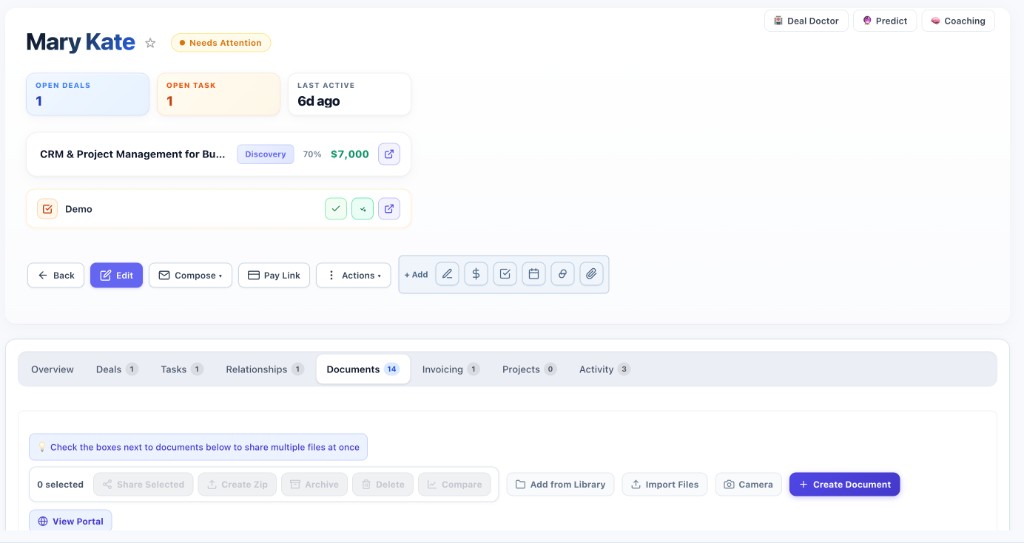
Pilot scope, security documentation, and agreements attached to the opportunity they belong to.
Turn a signed deal into implementation without rebuilding the stakeholders, requirements, documents, pricing, tasks, and commitments collected during the sale. For AI companies this is the highest-risk handoff in the business — the gap between what was sold and what gets built.
The connections promised in evaluation, tracked as tasks with owners on both sides.
Environment setup, tuning, thresholds, and the workflow changes their team agreed to.
Historical data loaded, with the file exchange and sign-off running through the customer portal.
Sessions for administrators and end users, scheduled as milestones against the plan.
Expand from one team to the organization as stages of the same plan, not a new spreadsheet.
Sign-off on configuration and deliverables in a portal, so acceptance has a record.
You sell AI, so you'll recognize an overstated claim faster than most buyers. Here's exactly what's in the product.
Ask is a conversational assistant over your own CRM data. It answers questions in plain English and can take the follow-up action — create a task, log a note, move a stage, draft a follow-up email, file a call recap as a note plus a meeting plus an updated deal value. Included on Pro.
It doesn't research companies on the web, record your calls, or enrich contacts on its own. Meeting transcripts are pasted or uploaded, not captured automatically.
Deal health is a deterministic 0–100 score built from concrete signals: time since last activity, whether a next action exists, how long the deal has sat in its stage, whether a decision maker is identified, whether a proposal is unsigned, and overdue tasks. It shows its reasoning. It is not a machine-learning close-probability model, and calling it one would be exactly the kind of claim you'd catch.
AI revenue often arrives in stages, and those stages come out of the sale.
Pilot and proof-of-concept fees, implementation and integration work, professional services, deposits, milestone payments, and the first annual agreement. Created from the deal or the implementation plan, collected through Stripe by card or bank payment, with sent, viewed, overdue, and paid status visible to the team.
Usage-based and recurring subscription billing belongs in Stripe Billing or an equivalent platform, and accounting belongs in QuickBooks or similar. TotalDeal is neither, and doesn't try to be. Invoices sync to QuickBooks Online or export for QuickBooks Desktop.
On renewals and expansion: there's no dedicated renewal-management module. You can open a new opportunity on the same account with the original deal, stakeholders, pilot results, signed agreement, implementation plan, and invoice history already in place. If renewal automation is central to your motion, raise it on a demo before you commit.
AI companies selling into businesses through a human sales process — applied AI products, agents, copilots, vertical AI tools, and AI consulting or implementation work. The fit is strongest when a deal involves several stakeholders, a technical evaluation, a pilot, and integration work after signature. A self-service API with credit-card signup isn't the right fit.
Yes. Run the pilot as a plan with its own tasks, milestones, owners, and dates, linked to the opportunity that created it. Success criteria and data-access commitments live as notes and documents on the deal, so when the pilot ends there's a record of what was agreed rather than a recollection of it.
No. Deal health is a deterministic score from concrete signals — activity gaps, missing next actions, stage stalls, no decision maker identified, unsigned proposals, overdue tasks — and it shows its reasoning. It's not a machine-learning prediction, and we'd rather describe it accurately than dress it up.
Both invoice from the deal or the implementation plan and collect through Stripe, as deposits or milestones. Recurring subscription billing and accounting stay in Stripe Billing and QuickBooks; invoices sync to QuickBooks Online or export for QuickBooks Desktop.
Security questionnaires, DPAs, data-handling documentation, and architecture diagrams live in the deal's document library with version and approval status. The reviewer is added to the deal as a stakeholder with a role, so a stalled review has a name attached to it. For TotalDeal's own security posture, see the security overview.
Pro is $199 per month for unlimited users, so adding sellers doesn't change the bill. Starter is $99 per month for up to five users and covers the core sales workflow; AI, documents, portal, and invoicing are on Pro. Full pricing →
A 30-minute walkthrough covering your stages, stakeholders, pilot tracking, security review, implementation handoff, and billing path.