Fewer deals, each one heavier
Thirty live opportunities where any one of them matters means the cost of losing track of a single deal is high. Volume tooling optimizes for the opposite problem.
If your software sells through demos, a technical evaluation, a security review, and an implementation on the other side of the signature, your CRM needs to hold all of it. TotalDeal connects the buying committee, the evaluation trail, the order form, and the onboarding that follows.
Plenty of CRMs are built for high-volume, low-touch pipelines: a lot of leads, a short cycle, one contact per deal. That's a real motion — it just isn't this one.
Thirty live opportunities where any one of them matters means the cost of losing track of a single deal is high. Volume tooling optimizes for the opposite problem.
A champion wants it, an economic buyer approves it, IT or security has to clear it, and sometimes procurement runs its own process. The deal advances only as fast as the slowest of them.
Demo recordings, trial notes, a requirements list, a security questionnaire, an architecture diagram, a DPA, an order form. Six months later somebody will need to know what was agreed.
Data migration, SSO configuration, integrations, admin training, a pilot group. If none of that is in the CRM, the sales team's knowledge doesn't reach the people doing the work.
If your product is self-service — customers sign up with a card and never talk to anyone — TotalDeal is the wrong tool, and we'd rather say so here than on a sales call.
Add every stakeholder to the opportunity with a role. When a deal has no decision maker identified, deal health flags it — which is usually the earliest warning that a friendly champion has no authority.
Roles are yours to define. The point is that a manager can look at a deal and see which seat is empty.
Everything the deal produced, attached to the deal that produced it.
Log each meeting against the opportunity with what was shown, what was asked, and what you committed to next. Paste or upload a transcript and summarize it.
Capture what the buyer needs and what's standing in the way as notes on the deal, so the next call doesn't start from zero.
Store the questionnaire, your responses, the architecture doc, and the DPA in the deal's document library with version and approval status.
Run a trial or pilot as its own plan with tasks, owners, and dates, linked to the opportunity it belongs to.
Build the proposal or order form from what the deal already knows, then send it for review and signature.
See sent, viewed, commented, and signed without asking. Automatic reminders when an order form is viewed but not signed.
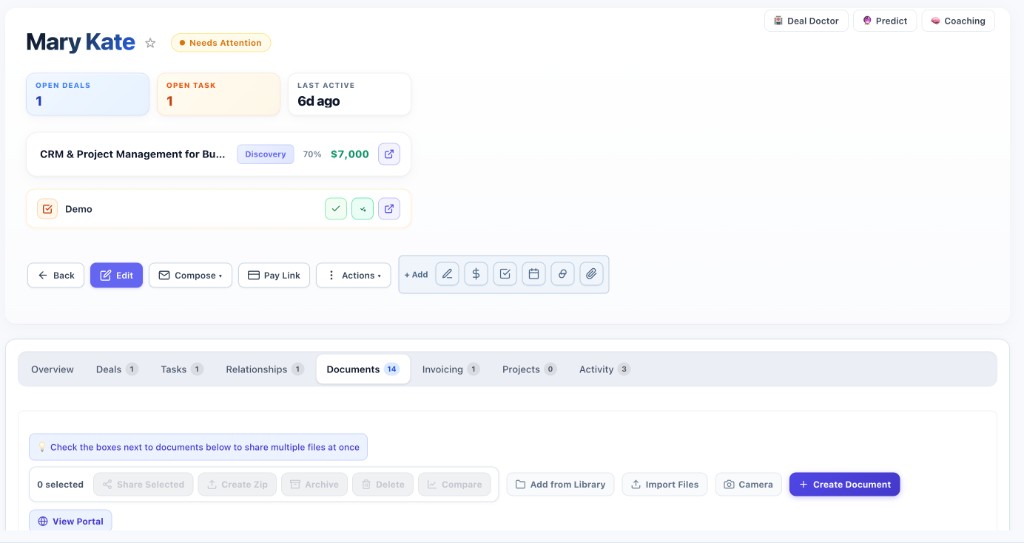
Documents attached to the opportunity, with review and signature status visible to the team.
The lead lands from a website form, or you import the target account list you're working.
Record fit, seat count, budget authority, timing, and the reason they're looking now.
Add each stakeholder with a role as you meet them. The gaps become visible immediately.
Track the trial as a plan. Keep integration questions and requirements on the deal.
Questionnaire and DPA in the document library. The reviewer is a named stakeholder, so the delay has an owner.
Send for review and e-signature. Watch it move from sent to viewed to signed.
Convert the deal into an onboarding plan that inherits the account, contacts, owner, and value.
Bill implementation, setup, and the first-year agreement from the deal, and collect through Stripe. Optional.
Turn a signed deal into customer onboarding without rebuilding the stakeholders, requirements, documents, pricing, tasks, and commitments collected during the sale. Closed Won is the beginning of the customer relationship — not the end of the CRM workflow.
Import from their old system, with the file exchange and sign-off running through the customer portal.
Environment setup, SSO, permissions, and the integration work promised during the evaluation.
Sessions scheduled as tasks and milestones against the onboarding plan, with owners on both sides.
Start with one team, then expand — tracked as stages of the same plan rather than a separate spreadsheet.
The customer reviews, comments, approves, and uploads in a portal instead of an email chain.
Custom integration and services work billed as milestones as it's delivered.
This is the question SaaS teams ask first, so here's the straight answer.
Charges that originate in the sale: implementation and setup fees, the first annual agreement, professional services, deposits, and milestone payments. Created from the deal or the onboarding plan, collected through Stripe with card or bank payment, and visible as sent, viewed, overdue, or paid.
Recurring subscription billing, usage metering, proration, and dunning belong in Stripe Billing or an equivalent platform, and your accounting belongs in QuickBooks or similar. TotalDeal is neither. Invoices sync to QuickBooks Online or export for QuickBooks Desktop.
On renewals and expansion: there's no dedicated renewal-management module. You can open a new opportunity on the same account, where the original deal, stakeholders, signed agreement, implementation plan, and invoice history are already sitting. If renewal automation is central to how you operate, raise it on a demo before you commit.
Ask reads your own CRM data to answer questions and take the follow-up action. Included on Pro.
To be clear about the limits: Ask works from the data in your workspace. It does not research accounts on the web, record your calls, or enrich contacts on its own. Deal health is scored from concrete signals — activity gaps, stage stalls, no decision maker, unsigned proposals, overdue tasks — not an opaque prediction.
No. If customers sign up with a credit card and never speak to anyone, a CRM built around multi-stakeholder deals is the wrong tool. TotalDeal fits SaaS companies whose deals involve demos, a technical evaluation, several stakeholders, and an implementation after signature.
No, and it doesn't try to. Recurring billing, metering, proration, and dunning belong in Stripe Billing or an equivalent. TotalDeal invoices the charges that originate in the sale — implementation and setup fees, professional services, the first annual agreement, deposits, and milestones — and collects those through Stripe.
Yes. Security questionnaires, architecture documents, and DPAs live in the deal's document library alongside the proposal, with approval and version status. The reviewer can be added to the deal as a stakeholder with their own role, so it's clear who's holding the deal up.
There's no dedicated renewal-management module. You can create a new opportunity on the same account, where the full history is already present — original deal, stakeholders, signed agreement, implementation plan, past invoices. For teams at this size that's usually enough. If renewal automation is central to your motion, ask about it on a demo first.
Marking a deal Closed Won converts it into an onboarding or implementation plan that inherits the account, contacts, owner, and value, and stays linked to the original opportunity. Whoever runs onboarding reads the requirements and commitments captured during the sale instead of asking the customer to repeat themselves.
Pro is $199 per month for unlimited users, so adding sellers doesn't change the bill. Starter is $99 per month for up to five users and covers the core sales workflow; AI, documents, portal, and invoicing are on Pro. Full pricing →
A 30-minute walkthrough covering your stages, buying committees, security review, order form, and implementation handoff.